
Appalachian Trail icon Warren Doyle attempts his 16th thru hike in 2010. Speed record holder Jennifer Davis reflects on Doyle’s influence and inspiration.
December 2004
Lees McRae College. Banner Elk, North Carolina
I didn’t know who Warren Doyle was when I signed up for his four-day Appalachian Trail Institute. All I knew was that I wanted to thru-hike the Appalachian Trail and that only one in four people who attempted the trail would succeed, but I read that 75 percent of folks who attended Warren Doyle’s ATI workshop completed the trail. I was here to boost my odds.
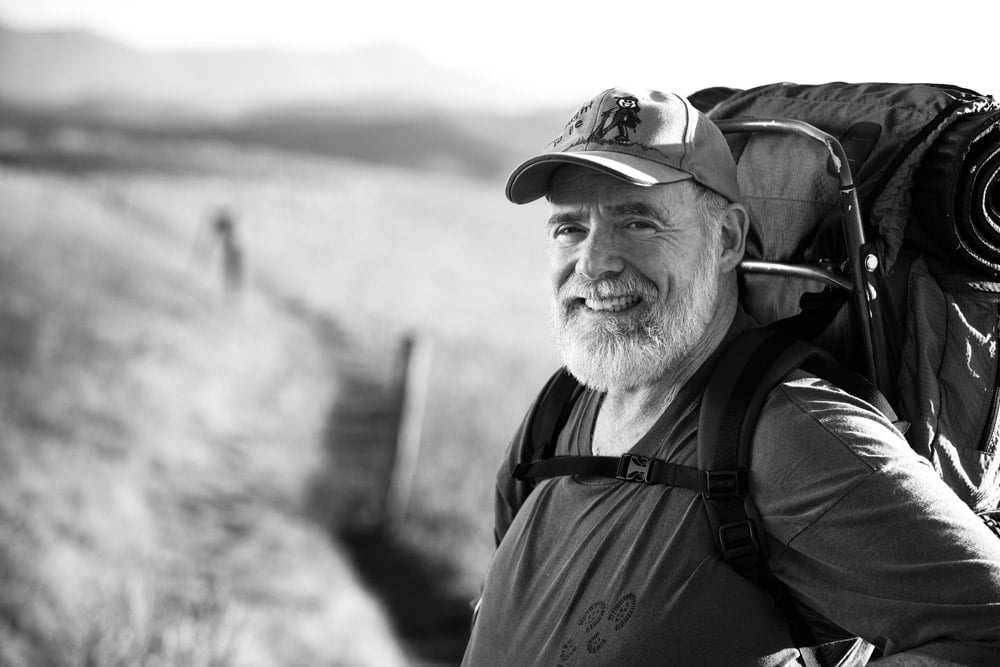
I thought that the person who has hiked the Appalachian Trail more than anyone else would be mentally and physically imposing. But Warren had white hair and a soft belly, a smile on his face and a gleam in his eyes. He looked more like Santa Claus than an accomplished hiker.
“To start our time together,” said Warren, “I am going to give each of you a copy of my book.”
I thought he was kidding when he handed us each a one-page, front and back, piece of paper. He wasn’t. I also thought we would spend the morning talking about gear and logistics. But we didn’t.
“It is not your gear that will get you to Katahdin,” Warren started. “It is your heart and your mind.”
Then he asked us to read aloud from his book. He called on me and I started, “Time, distance, terrain, weather, and the Trail itself cannot be changed. YOU have to change. Look to yourself and adapt your mind, heart, body and soul to the Trail.”
 June 2006
The John Muir/Pacific Crest Trail. Sierra Nevadas, California.
Warren’s ATI worked. It worked so well, that after completing the Appalachian Trail, the following summer I headed west to try my luck on the Pacific Crest Trail. Even on a different trail, I was indebted to the lessons that I learned at the ATI. Because, while Warren did eventually cover the logistics of thru-hiking, I learned, above all, not to be intimidated by hikers with “proper” gear, or to let other people tell me that I shouldn’t or couldn’t do the trail. I learned to trust my heart, use my head, and remain flexible amid uncontrollable conditions.
One factor on the PCT, beyond my control, was the record-breaking snowpack in the Sierras. I was hiking alone and as I came to the top of a snowy pass, I saw a figure in the distance coming towards me. But he wasn’t hiking, he was leaping and sliding down the slopes, like a kid playing in the first snow of the season. Then a voice called out, “Wooo Hooo, Jennifer, is that you?”
I didn’t know anyone out here, and the people I did know called me by my trail name. But as the figure gleefully approached, I recognized Warren and his wife Terry. I connected Warren so strongly to the AT that it was disorienting to find him on another trail.
“What are you doing out here?” I called.
He laughed. “This is actually my second thru hike on The John Muir Trail. I’ve also hiked the Wonderland Trail and soloed Mount Rainier, Hood, Shasta, St. Helens and Olympus.”
“Wow. I didn’t know that you ever left the AT!”
“So how is the PCT treating you?” Warren asked.
“It’s great, but my pack is really heavy because of all the food you have to carry.”
“I know,” said Warren. “I am carrying 14 days worth of Little Debbie brownies.”
“And what else?”
“To eat? Nothing, just Little Debbies. John Muir came out here with just tea and bread. I’m like a modern day John Muir.”
July 2007
A gas station off I-81. Winchester, Virginia
“I wanna go fast.” I told Warren on the phone.
“You mean efficiently,” he said.
“I’m thinking about the A.T.,” I proposed.
“Why don’t you try the Long Trail first to see if you like it? I can help you with your planning. I am driving up to Connecticut for a hike. I could meet you at midnight off the interstate for a planning session.”
When we rendezvoused at the gas station, Warren talked me, mile-by-mile, through the Long Trail.
“How do you know the Long Trail so well?” I asked.
“Well, I’ve hiked it five times,” he said.
“Right. Okay, I’m listening.”
After an hour and a half, I left with a personalized itinerary for hiking the Long Trail. A week and a half later I called Warren from Vermont.
“Warren! Guess what? I just hiked the Long Trail in under eight days.”
“Congratulations! That means you now hold the unsupported record for both men and women.”
I knew that I could believe Warren because he had been the unofficial keeper of trail records for several decades.
“Cool! Whose record did I beat?”
Warren chuckled. “Mine.”
 August 2008
The Appalachian Trail, Northeast Georgia
It’s not like I was purposely trying to go after Warren’s records. I didn’t know that in 1973, he set the Appalachian Trail record by hiking it in 66 days. But if my attempt bothered him, he probably wouldn’t have helped me so much.
I was 55 days into my record hike and a day and a half from the finish. Last May, Warren helped me with my itinerary and told my fiancé Brew all the best places to meet me for support. In July he came to check on us in the rocky state of Pennsylvania, and now he was helping us to the finish.
I was too excited to sleep, but I didn’t like night hiking. Warren, knowing the trail better than anyone, agreed to help me navigate the morning darkness. We started at 3 a.m. and with my gaze locked on the back of his sneakers, Warren filled the night and the woods with his stories.
When he told me that he had been arrested, I was shocked.
“It’s true,” he said. “I spent a night in jail for climbing Katahdin.”
“They put you in jail for climbing a mountain?” Warren laughed. “Well, I did it as an act of civil disobedience. In 1975, I led my first A.T. Expedition group. We were 19 university students from the University of Connecticut and we started together, stayed together, and on the 110th day we finished together at the base of Katahdin. But we had to go back to school and come back two weeks later to climb the final mountain.”
“Why?”
“Because it was raining.”
“What does that have to do with it?”
“In the 1970s, the Baxter State Park Authority wouldn’t let you climb Katahdin in the rain. It was the only mountain in America that prohibited climbing when raining during the summer. After our group was denied our final five miles, I tried to get this policy changed in subsequent years by going through the proper channels. When this effort did not work, I decided, as an act of protest, to climb Katahdin in the winter without a permit.”
“And that’s when you got caught?”
“Yes, the judge ordered me to pay a $20 citation or spend 24 hours in jail. I opted for jail. I wanted to raise awareness about the unusual rules and regulations in Baxter State Park.”
“What happened after that?” I asked.
“A few years later they changed the rule.”
In the early 1980s, Warren founded he Appalachian Long Distance Hikers Association (ALDHA). After completing my hike, Warren asked me to go to the ALDHA Gathering. I knew that Warren had been criticized within ALDHA for a poem that he read during the 2001 Gathering. I didn’t know much about the organization or the poem, but I didn’t like the idea that a group could temporarily turn its back on its founder for reading a poem.
I also didn’t like reading the online forums where Warren was verbally attacked. His desire to educate and agitate made Warren a source of controversy in cyberspace. People criticized Warren’s methods and beliefs, and even questioned his credentials. His credentials? Really?
It seemed ironic that prominent trail organizations and websites carry such varied and erratic views of Warren, when I am convinced that he loves the trail more than anyone else. He even calls the trail his “higher love.”
September 2009
Poorman’s Biltmore. Rural Northeast Tennesse
Sitting on the porch of a 200 year-old farmhouse, Warren and I watch the morning haze lift from the ground. My husband and I have come up for a visit and to see Warren and Terry’s new home.
“I have decided to call it the poorman’s Biltmore,” said Warren. “We are going to have one room where we can teach waltz lessons, another room where we can sell quilts, and a library full of books. All the Appalachian Trail Institutes will be held here, but I am going to change the name to The Appalachian Trail Folk School—institute sounds too institutional.”
Warren’s aversion to institutions makes me laugh. He has spent his entire life working within academic institutions, teaching Education and Appalachian Studies to students throughout the southern Blue Ridge mountains. But, amid his busy teaching schedule, he has always found a way to keep one foot on the trail.
Nearly 60 years old, Warren has now completed the trail almost 15 times. This spring, he will hike stretches in Pennsylvania and Connecticut to complete a section hike, and in May he will start his 16th thru-hike with his eighth, and probably last, Expedition group.
“Warren,” I asked, “if you don’t get paid for the Expeditions, then why do you do them?”
“It’s the most productive thing I can do as a social change educator. In my seven Expeditions, I’ve only had one group circle broken before reaching Katahdin.”
“You mean every group Expedition had a 100 percent success rate except one?”
“That’s right. Participants have to go through a set of rigorous training hikes before the Expedition, and then once the journey starts, 100% completion becomes the task to be accomplished. After my record hike in 1973 and then the first expedition in 1975, I discovered that completing the Appalachian Trail in one hiking season is an achievement and completing the trail in an even shorter time is a greater achievement. However, doing the trail as a group, with everyone who started together finishing together, that is the greatest achievement.”
Katmandu, the cat that came with the house, interrupts Warren by jumping into his lap. Warren smiles and pets his new friend. As we sit there and listen to Katmandu purr, I look around and start to think of all the ways Warren juxtaposes himself. His feet have carried him over 30,000 miles yet in his yard is a collection of cars that he bought at auction; his legs are toned from dancing and hiking but his belly is still soft from Little Debbies; he has furrowed lines on his brow, from the study of books, which contrast against his sun-kissed, windswept cheeks; and although Warren has critics, he also has a strong inner circle of friends who consider him both sage and kind.
I never would have guessed, six years after signing up for the Appalachian Trail Institute, that I would still be friends with Warren Doyle. But just like at our first meeting, he continues to teach and inspire me every time we are together.
“So Warren, why the AT?”
“What do you mean?”
“Well, there are a lot of trails out there. Why the A.T. over and over again?”
Warren pauses and then smiles. “The Appalachian Trail is my measure of growth. The reason I hike the Appalachian Trail again and again is the same reason I waltz the same way over and over, because it is beautiful; because it is what I feel is right; and because it can’t get any better.” •


